When a person falls down before you, the clock quits being abstract. You listen to the superficial gasps, or you do not hear breathing at all. You feel for a pulse and your hands are not as consistent as you anticipated. That is the minute every glossy pamphlet regarding a first aid course is discussing, but it does not really feel like a pamphlet. It seems like a test.
I have educated people in first aid and CPR for enough time to see two patterns. First, nearly everyone indicates well and wishes to aid. Second, many delay training because they assume it will certainly take way too much time, be also technological, or require a multi day dedication they can not manage.
Fast first aid courses and express CPR training are a feedback to that truth. The good ones trim the fat without cutting out the skills that in fact save lives. The negative ones feel like a rushed slideshow that supplies a printable first aid certificate however not much competence.
This overview has to do with informing those two apart, comprehending what you absolutely need from first aid and CPR training, and exactly how to get fast certification without short changing safety.
What "fast" truly implies in first aid and CPR training
Different carriers quietly mean different points when they advertise a fast first aid course or express CPR course. Sometimes "fast" is marketing language split onto a basic routine. Other times, it genuinely reflects a compressed layout, mixed understanding, or assessment just options.
In practical terms, fast first aid training generally looks like among three designs:
A short, totally face to face first aid course that runs for half a day rather than a full day. An express first aid course that uses online concept plus a much shorter useful workshop. An assessment based layout where skilled people demonstrate skills without sitting through the full class.Fast CPR courses professional CPR and first aid training often tend to be also much shorter. A concentrated express cpr course may run 60 to 90 minutes in person, often with pre knowing online. A fast cpr refresher course can be under an hour for individuals who exercise abilities frequently, like registered nurses or lifeguards.
None of this is instantly good or bad. What matters is what gets compromised to gain speed. If technique time, feedback, and realistic situations are gotten rid of, the moment you save money on the course might be lost in doubt during a real emergency.
What you must really find out in a fast first aid and CPR course
A fast layout does not excuse missing foundations. Whether you select a requirement, fast, or express first aid course, the core capability need to be recognisable.
Here is what a strong fast first aid and CPR course need to cover at minimum:
Risk analysis and scene safety and security: Looking for dangers before you hurry in. Airway, breathing, flow: Simple methods to assess responsiveness, breathing, and pulse if applicable. CPR training: Reliable chest compressions, rescue breaths if consisted of in your neighborhood guidelines, and use an AED. Bleeding control and shock: Straight pressure, elevation when appropriate, and early acknowledgment of shock. Essential first aid: Choking, burns, fractures or thought fractures, and allergic reactions, especially anaphylaxis and vehicle injector use.Some fast first aid courses will also include brief protection of clinical conditions like stroke, bronchial asthma, diabetes mellitus, and seizures. The deepness differs. In my experience, a fast first aid course that spends at the very least time on stroke acknowledgment and asthma is far more beneficial than one that avoids directly from CPR to bandaging games.
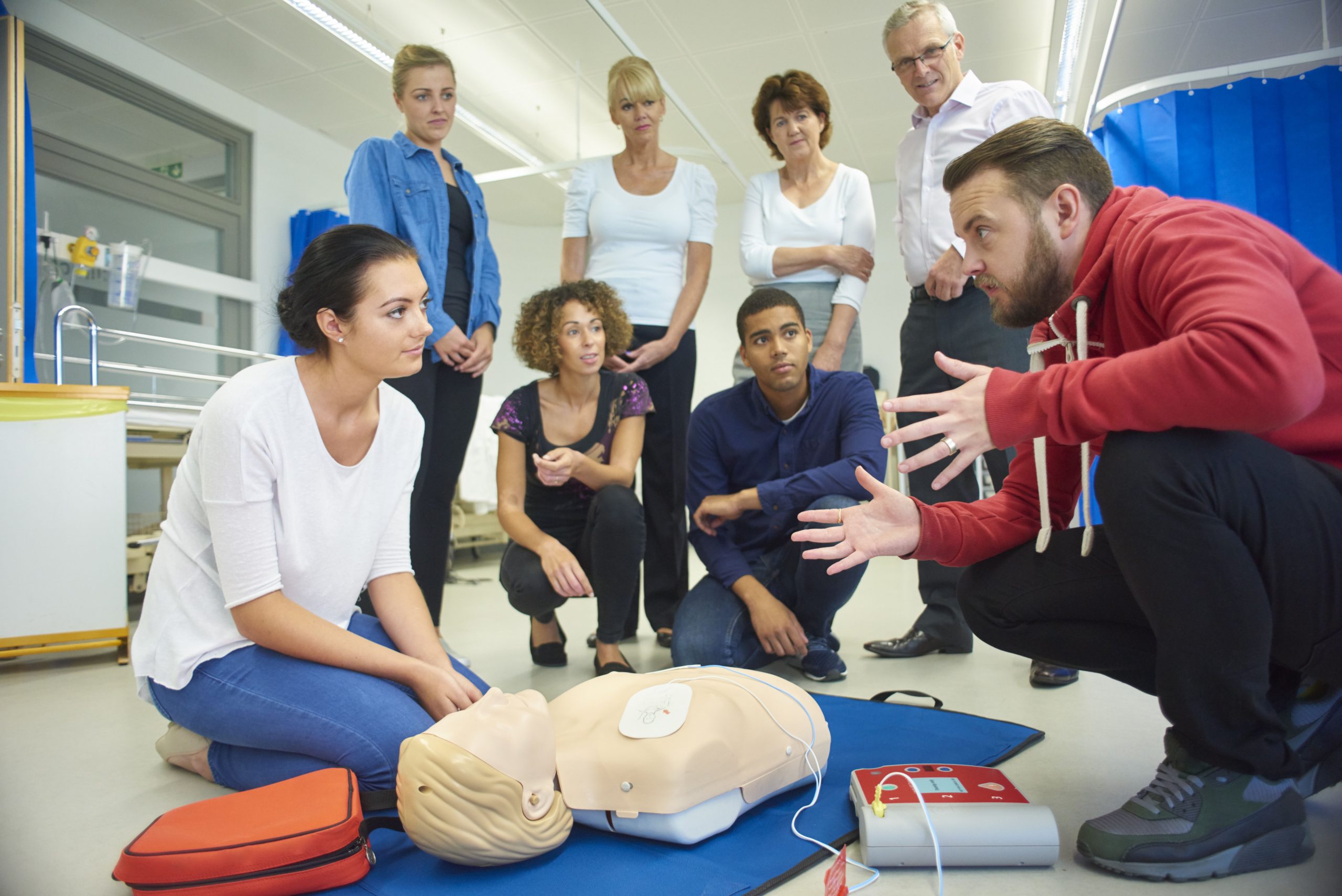
For child care professionals, express childcare first aid training requires to include child certain web content: infant CPR, choking in toddlers, fever administration, and youngster safe positioning. If you deal with children, a common fast first aid course is hardly ever enough. Search for an express childcare first aid course or full childcare course, also if it is a little longer.
Online, blended, and in person: how fast layouts actually work
Fast and express first aid courses normally cut time by modifying exactly how and where you discover. Recognizing the compromise will assist you pick the right format.
Fully personally fast first aid training presses descriptions and minimizes repetition. A knowledgeable instructor can do this without injuring top quality. The restriction is that the space still has a physical pace. 10 individuals sharing one manikin can not all press simultaneously. If the course is also short, practice goes down first.
Blended or express first aid courses move a lot of the concept online. You could enjoy video clips on CPR, checked out hemorrhaging control, and respond to quizzes prior to you enter a classroom. The personally element after that concentrates on hands on skills, situations, and assessment.
Done well, mixed discovering can be extra effective than a longer traditional course. Students arrive with fundamental expertise and invest their time compressing, rolling, and improvisating. Done inadequately, it turns into a box ticking workout where everyone skims components the night before and without delay neglects them.
Fully on-line CPR courses or first aid courses, without in person technique whatsoever, are where I see one of the most troubles. They are great for standard understanding, and often appropriate for low danger functions that just need academic understanding. Yet if you have never ever literally locked your hands on a breast, cpr training Cannon Hill counted your compressions aloud, and really felt how much force is really needed, you are not prepared for real CPR.
For first aid and cpr training classes that result in a widely identified first aid certificate, a lot of authorities still need some in person component. If a service provider uses fast certification without hands on training, read the small print, specifically if your employer, regulatory authority, or insurance provider has rules concerning accepted first aid certificates.
How fast is too fast?
Everyone desires effectiveness. The concern I ask when I investigate fast first aid courses is easy: what would I expect a pupil to keep in mind 3 months from now?
If the course is pared down so much that individuals hardly touch a manikin or plaster, you see a pattern. They leave with facts, not behaviors. They can tell you the compression to ventilation proportion, but their hands slide on the breast and they do not press deep enough.

As a harsh criteria, for a person without previous experience:
- A durable express cpr training session, with pre discovering, still needs at least 45 mins of real compressions, exercise with an AED trainer, and feedback. A fast first aid course that consists of CPR, bleeding, shock, choking, and a handful of vital problems needs around 3 to 4 hours total, presuming good use of on-line modules.
Shorter than that and something is missing out on. In some cases that is situations. Occasionally it is individual evaluation. Often it is the opportunity to ask those "what happens if" inquiries that make the difference in between inflexible book reasoning and flexible real life response.
That stated, if you currently have normal exposure to emergencies, such as paramedics, security officers, or lifeguards, fast cpr refresher courses and brief first aid refresher courses can be very efficient. For these students, the goal is correction of drift and updates on guidelines, not instructing from scratch.
Choosing a fast course carrier that does not cut corners
Not all fast first aid courses or express CPR courses are developed equal. Price and closeness matter, but they are not the only aspects. I have seen affordable, fast first aid training where the instructor primarily read slides, and I have seen well structured express first aid training that left people truly much more prepared.
A brief list assists when you analyze carriers:
Accreditation and recognition: Are their first aid and cpr courses lined up with recognised bodies or national standards in your country or region? Trainer experience: Are the teachers real professionals or at the very least seasoned trainers with field exposure, not just individuals reading a script? Practice time: The amount of individuals per manikin or scenario? If it is greater than 4 or 5 per manikin for CPR training, anticipate thin practice. Content quality: Does the course synopsis clearly mention CPR, bleeding control, choking, and AED usage, not simply vague "emergency situation treatment" wording? Assessment criteria: Does everyone obtain independently evaluated on CPR and essential first aid skills, or is the first aid certificate immediately issued for attendance?If you are looking for a fast first aid course near me, utilize that expression as a beginning point, after that drill right into these details. A short call to the service provider can disclose a whole lot. Ask just how they take care of learners without any previous experience, the length of time you will certainly have your hands on a manikin, and whether there is any pre course work.
When a supplier can not respond to those inquiries clearly, or seems irritated by them, that is a signal.
What fast first aid looks like in actual emergencies
I bear in mind a young friendliness manager that pertained to a night express first aid course after a near miss out on at work. Among his staff had collapsed in the cool space. No one understood whether she was taking a breath effectively, and they argued about whether to relocate her while waiting for a rescue. She recovered, but the supervisor understood exactly how unprepared they were.
He might not save team for a full day course, so he scheduled a fast first aid and cpr course: mixed concept and a 3 hour functional. He took it seriously. By the time he strolled into the session, he had completed the online first aid training modules and created inquiries on a notepad.
Two months later on, a consumer had a cardiac arrest in the restaurant. That manager launched CPR before any person else, asked a coworker to grab the AED from the shopping mall corridor and had it attached within a number of mins. The paramedics attributed the very early compressions and shock with giving the man a combating chance.
He did not become a paramedic by going to an express first aid course. What he gained sufficed clarity to act instead of freeze. That is the realistic goal of fast first aid: not mastery, however decisive capability in the very first important minutes.
Balancing speed, depth, and your genuine risks
Not every person requires the very same level of first aid and cpr training. A solo freelancer functioning from home has an extremely various risk profile to a building and construction foreman, childcare employee, or physical fitness instructor.
For reduced risk workplaces, a fast first aid course plus fast cpr refresher course yearly or more can be enough, especially if a number of people share the obligation. For greater threat duties, express first aid may be ideal only as a supplement in between full length renewals.
Think concretely regarding your atmosphere:
A childcare employee or instructor should prioritise express childcare first aid courses, also if they take longer than a common fast first aid course. You require to manage baby choking, febrile seizures, and allergies, commonly in small bodies where errors magnify.
A health club proprietor or team trainer should focus heavily on CPR training, AED usage, and heart emergencies, coupled with a strong baseline of first aid. A targeted express cpr training session for all staff can be vital, with even more comprehensive first aid training for crucial people.
A building website supervisor or factory manager needs deepness in injury, hemorrhaging control, crush injuries, and ecological direct exposures, not just book CPR. A marginal fast first aid course might not supply adequate method on these circumstances. Try to find fast first aid courses that clearly consist of work environment risks appropriate to you.
Fast can not mean superficial when the risk is high.
What to anticipate throughout a great express first aid or CPR class
When you stroll right into a well run express first aid course, the environment really feels concentrated instead of hurried. The fitness instructor does not waste time on lengthy intros or unimportant war stories, but they also do not bark through content like a scripted exam prep.
You can expect a rhythm. Short ruptureds of description, then technique. A trial of compressions, after that everybody moves to manikins. A fast go through indicators of stroke, after that a situation where you need to acknowledge slurred speech and one sided weakness in a duty play.
In high quality fast first aid courses, the instructor makes use of basic, repeatable frameworks as opposed to long checklists. For example, they could anchor whatever around three large questions: is it safe, what is incorrect, what can I do currently. Within that framework, you plug in your understanding of breathing checks, hemorrhaging control, and so on.
In CPR training, search for energetic modification. A trainer who walks, adjusts your hand placement, asks you to push more challenging, and uses responses manikins where possible deserves their fee. Watching a video clip and after that exercising for 30 secs is not.
During express cpr courses that include AED method, you should manage the training device several times, from opening up the lid to affixing pads and following motivates. It is inadequate to watch the teacher. Under stress, muscle mass memory counts.
The function of refresher courses and method after fast certification
Any first aid certificate has a suggested expiration day, whether published or otherwise. Skills degeneration fast if you never use them. Study and experience both show that CPR high quality drops significantly within a year for most people who do not practice.
That is where fast cpr correspondence course earn their area. Since the foundation has actually currently been laid, refreshers can be shorter and much more concentrated on drills, updates, and fixing negative behaviors. Attending a brisk, useful session every year is far more reliable than recertifying every three years with a lengthy course that mainly duplicates theory.
Outside of formal courses, construct small routines:
Use a timer application or metronome sometimes to practice breast compressions on a company surface at home, making use of a pillow. It is not comparable to a manikin, yet it strengthens rhythm and body mechanics.
Mentally rehearse your steps when you walk right into new atmospheres. Where is the AED in this gym, shopping center, or office? How would I call for assistance right here? People that pre strategy like this often tend to act faster.
Share what you found out with associates or family. Teaching, even informally, reinforces your recall.
Many express first aid training providers send e-mail updates when standards change, such as alterations in CPR series or bleeding control suggestions. Check out those. They are normally brief and practical.
Special factors to consider for child care first aid in fast formats
Childcare setups are one location where I routinely push back when employers want the fastest, cheapest alternative. Kids are not simply small grownups. Their respiratory tracts, essential indicators, and common emergency situations vary enough that generic first aid training can leave harmful gaps.
An express child care first aid course should still be fast, however it must consist of hands on infant and youngster CPR, choking monitoring for infants and kids, kid details recovery positions, and practical scenarios like play ground injuries, allergic reactions at lunch, and unresponsive infants in cots.
If a supplier uses express child care first aid courses that are really much shorter than their adult just fast first aid courses, ask what has actually been removed. In my view, it is better to schedule a slightly longer express childcare first aid training session than to cut critical pediatric content just to fit a slim time slot.
For moms and dads, a personal express child care first aid course in the house, run by a qualified instructor, can be among one of the most beneficial afternoons you invest before an infant gets here. You may fail to remember the trade names, yet you will remember what to do when a young child starts choking on an item of food.
Matching your inspiration to the ideal type of course
People book fast first aid courses for different reasons. The inspiration matters.
If you are chasing a box tick, such as an office demand, you may be attracted to pick the outright minimum: a very short course, at the lowest rate, on the nearest date. You will likely still satisfy your compliance obligation. Just be honest with on your own concerning what that acquires you in an emergency.
If your motivation is personal, such as caring for elderly parents or wishing to work in your area, it is usually worth extending a little. Maybe pick an express first aid course that includes an added hour of circumstances, or incorporate a fast first aid course with an additional dedicated CPR training session later in the year.
Some employers compromise well by sending out a nucleus to a much longer, a lot more detailed first aid and cpr course, then organizing express cpr courses or fast first aid refresher courses for the rest of the personnel. By doing this, there is always someone on site with deeper training, supported by associates who contend the very least strong basics.
When you understand your very own reasons, the marketing around fast first aid ends up being less complicated to filter. You quit going after the shortest choice and start searching for one of the most appropriate one.
When is fast not appropriate at all?
There are situations where I would certainly not suggest a fast first aid course as your primary or only training.
If you are going into an occupation where very first action is part of your core task, such as security, outside experience leading, lifeguarding, or healthcare support work, you require more time in circumstances, more deepness on medical conditions, and much more analysis than most fast layouts can supply. Express first aid can still play a role for refreshers, yet not as the initial foundation.
If you have significant stress and anxiety regarding emergencies or freeze conveniently in high pressure moments, a slightly longer, more sustained course might be much better. Hurrying with material when somebody is already strained can backfire. Reducing a little bit to develop self-confidence, with mild repeating, settles later.
If your workplace or regulator clearly needs comprehensive first aid and cpr training classes with established minimum hours, a shorter course may leave you non certified, also if it really feels valuable personally. Constantly examine the main wording.
Fast, express, and compressed styles are devices, not universal options. They work beautifully when matched to the best students and contexts.

Turning fast training into real life readiness
At its finest, a fast first aid or express cpr course appreciates your time while still treating emergency situations with the gravity they are worthy of. The trainer recognizes they have a restricted window to help you construct routines that will certainly surface under stress, so they focus on what absolutely matters.
You leave with a first aid certificate that pleases your company or regulator, yes. Extra significantly, you leave having actually felt your weight over a person's upper body, having actually listened to the AED voice motivates, having actually rehearsed those very first secs after you walk into a space and see somebody fell down on the floor.
That is the measure that counts.
If you will search for a fast first aid course near me or surf express first aid courses online, maintain a clear image in your mind: not the class, however the individual that might someday need you. Choose the course that prepares you to help that person swiftly, comfortably, and effectively, even if it includes an added hour or needs a somewhat longer drive.
Fast is useful. Proficient is crucial. Aim for both.